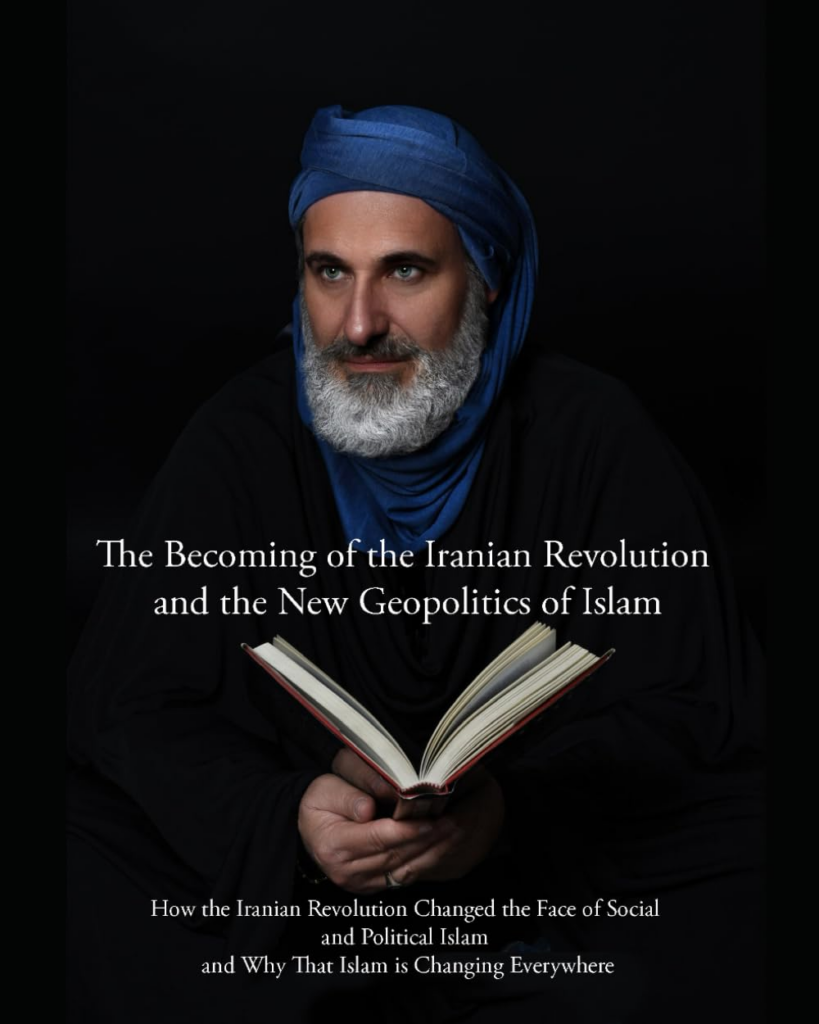
The Iranian Revolution is usually remembered as an Iranian event. This book treats it as a world-historical threshold: the moment when Islam was converted from a social and moral substrate into a sovereign grammar of power, capable of capturing a modern state and projecting influence far beyond borders. It explains how the Islamic Republic engineered “sacred statecraft” into institutions—constitutional authority, coercive architecture, welfare brokerage, and mobilisation narratives—so that endurance, sacrifice, and time could be turned into strategic assets rather than political liabilities.
The book then follows the diffusion of that proof-of-concept across the wider Muslim world. It shows why Iran’s model both energised and fractured political Islam: even where Shi‘ite doctrine was rejected, the operational repertoire—parallel security organs, proxy warfare, resistance economies, welfare ecosystems, and narrative discipline—became imitable. At the same time, rivals developed their own “state Islams”, producing a competitive landscape in which legitimacy is administered through ministries, clerical bodies, education pipelines, media control, and selective enforcement.
The central argument is that Islam remains geopolitically powerful, but that its power is changing form. Iran’s revolutionary model no longer dominates meaning as it once did, because the costs of monopoly have risen: urbanisation, mass education, and digital mediation have multiplied publics, interpretations, and moral vocabularies, making authority increasingly reputational and contested. Where the Islamic Republic can still compel, it struggles more to bind—an internal transformation with external consequences.
From this shift emerges the book’s core synthesis: “Islam as geopolitical power” is becoming less a single universal project and more a set of mechanisms that recur across theatres. It appears as state legitimacy infrastructure; as transnational cultural-moral mobilisation around specific causes; as networked proxy and welfare systems that convert asymmetry into resilience; and as an enduring identity field in diaspora arenas that interacts with Western politics, securitisation, and social cohesion. The outcome is not the retreat of religion from geopolitics, but a new geopolitics of Islam defined by competition—between states, movements, and moral grammars—where power depends on who can still transform religious capital into obedience, endurance, funding, and force.
Written in a documented, analytical style, the book offers an integrated framework for understanding how 1979 reshaped global politics, why Iran is changing from within, and how the world is entering an era of “competitive Islams” in which the sacred remains potent, but cannot be monopolised.
https://a.co/d/0beHww7u